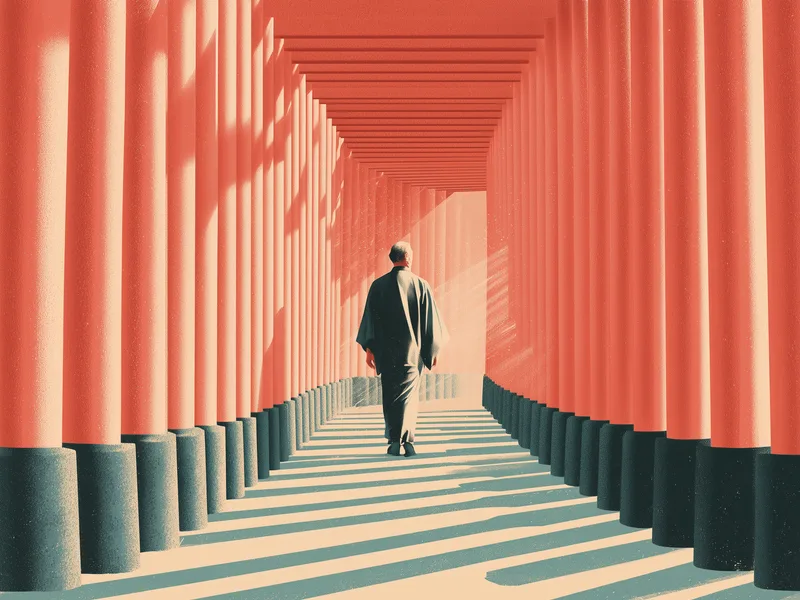
Four days on the Kyoto everyone comes for — Fushimi Inari, Kiyomizu-dera, Gion, Kinkaku-ji and Arashiyama — ordered so you meet each one in its quiet hour.
4 daysKyotoOne hotelCulture · Sights
Best for couples · friends · solo · families · 3 generations
Land softly — the south-Kyoto temples near the station if you land early, Fushimi Inari's torii in the late-afternoon light, then a tempura counter in Gion
MorningSanjusangen-doThe hall of a thousand gilded Kannon — 1,001 statues ranked down a 120-metre hall, five minutes from Kyoto Station and step-free indoors, so it is an easy first stop if you land early (no photos inside). Worth it only on a morning arrival; land by rail in the early afternoon and you'd skip this and Tofuku-ji below, picking up at Fushimi for dusk and dinner.
MorningTofuku-jiA great Zen temple whose covered bridge crosses a ravine of maples that turns solid red in November — quiet on an early-October weekday morning, long before the foliage crush. It is one rail stop north of Fushimi Inari, so it sits naturally on the way south; trims with the morning if you arrive in the afternoon.
LunchHonke Daiichi-AsahiA famous Kyoto ramen counter a few minutes from Kyoto Station, open from early morning (06:00) — a fast, cheap arrival-day lunch wherever the trains leave you, before the ride out to Fushimi. Expect a queue at the peak.
AfternoonFushimi Inari TaishaGo up after 15:00: the crowd peaks 10:00-15:00 in our data, and Kyoto City's guide calls the path an atmospheric late-afternoon stroll. Do the Senbon Torii tunnels and as far up as the daylight lasts (the full loop is 2-3 hours); the shrine asks you not to eat while walking or block the narrow paths for photos.
DinnerKyoto Tempura Ten no Meshi Gion HontenA 31-seat tempura counter in Gion, fried to order; reserve ahead (the seed flags reservations advised).
Day 2
Kiyomizu at first light, Higashiyama in kimono, tea in a townhouse, then Gion from dusk to lantern-light
MorningKiyomizu-deraOpens 06:00. The quiet window in our data is 06:00-08:00 (Tuesday is its quietest weekday) and Kyoto City's visitor guide says to come when few people are there. The approach is uphill — lighter options are in swaps.
MorningNinenzaka & SannenzakaStone-stepped lanes back down toward Gion; walk them now, before the day crowd builds, and mind the steps.
MorningKimono Rental (Higashiyama)Klook: dressing and hair-set from 09:00 at the Higashiyama shop. Our listing note says dressed by about 10:00 and back by 17:30, so the day is built around handing it in — the plan returns it around 16:45, before dusk in Gion. Book the first slot.
MorningKodai-jiOpens 09:00 (last entry 17:00): the garden temple a widow built for her warlord husband. Ishibei-koji, the stone-paved lane, is on the way from the kimono shop.
MorningMaruyama ParkKyoto's oldest public park — flat and step-free, with benches for a kimono rest.
LunchIzuju SushiKyoto-style saba (mackerel) and box sushi opposite Yasaka Shrine since 1912; English menu.
AfternoonKennin-jiKyoto's oldest Zen temple, quiet behind Gion; twin dragons painted on the ceiling. Closes 17:00, last entry 16:30.
AfternoonTea Ceremony Meditation in a 100-Year-Old MachiyaKlook: a 45-minute matcha ceremony hosted in English by a tea master inside a 100-year-old Kyoto townhouse, meeting at aeru gojo — a Klook's-choice listing rated 4.9/5 from 341 reviews (product page read 19 Sep 2026); pick a session that fits the day.
AfternoonKagizen YoshifusaA 300-year-old wagashi (tea-sweets) house in Gion — kuzukiri (kudzu-starch noodles) in the tearoom. Hand the kimono back after this.
AfternoonGion / HanamikojiBe here for the lantern hour, but not to chase geiko and maiko — they are on their way to work. Kyoto City's guidance: do not stop, touch, follow or photograph them without permission, keep out of private property, and stay to the road's edge without blocking it (no tripods).
AfternoonGion CornerKlook ticket (adult JPY 5,500): about 50 minutes of Kyo-mai dance by maiko, a tea ceremony, ikebana, koto, bugaku and kyogen in the Gion Kobu Kaburenjo annex beside Yasaka Hall. The operator runs it at 18:00 and 19:00 every day (its own page), so the 18:00 show follows the lantern hour by ten minutes' walk. This is the maiko performance that needs no introduction — Hanamikoji itself is only a glimpse. Book the ticket first: it fixes the evening.
DinnerMamaya (obanzai)An obanzai counter on Pontocho where you pick small Kyoto home-cooking dishes. Google lists it open 18:00-21:30 Tuesday to Sunday and closed on Mondays (checked 20 Sep 2026), so a 19:05 arrival after the show works any night except Monday. Reserve ahead — the seed flags reservations advised.
EveningYasaka ShrineLantern-lit at the end of Gion's main street and free at any hour; 20:00-22:00 is its quiet window in our data.
Day 3
Arashiyama at dawn, then the north-west temples in the late-afternoon quiet
MorningArashiyama Park (Kameyama)Kyoto City's guide suggests reaching the bamboo through Kameyama Park in the early morning; the lookout above the gorge is nearly always empty.
MorningArashiyama Bamboo GroveBe through by 08:00: 05:00-08:00 is the quiet window in our data and the crowd peaks 10:00-13:00 (Wednesday is the quietest weekday). Do not carve the bamboo — Kyoto City notes fines of up to ¥300,000.
MorningTenryu-jiOpens 08:30 (last entry 16:50): a 700-year-old garden that borrows the hills behind it; the back gate opens onto the bamboo.
MorningOkochi Sanso VillaA silent-film star's mountain villa beside the bamboo grove; entry includes matcha with the city below.
MorningTogetsukyo BridgeThe 'moon-crossing bridge' over the Katsura River — Arashiyama's hinge point, always open.
LunchArashiyama YoshimuraSoba with a Togetsukyo-bridge view — time the window seat.
AfternoonNinna-jiThe grounds are free outside cherry season; the paid part is the Goten palace gardens. Allow about an hour (the temple's own FAQ says so).
AfternoonRyoan-jiFifteen rocks in raked gravel; from no angle can you see all fifteen. Open 08:00-17:00 March-November (08:30-16:30 in winter); you arrive as the 11:00-14:00 peak fades, so give it the hour.
AfternoonKinkaku-ji (Golden Pavilion)Arrive after 15:00, its quiet window in our data (the peak is 12:00-14:00). It closes at 17:00, so you see the gold in the low late-afternoon light.
DinnerSarasa NishijinA café in a tiled 1930s bathhouse near Daitoku-ji, open until 21:00 with an English menu and vegetarian dishes; no booking is flagged in the seed. It keeps the last leg short — the hotel is a taxi ride back.
Day 4
Nijo Castle at opening, Kyoto's kitchen market and a soba lunch, then the downtown arcades and a hexagonal temple to end on — the fuller slate if your train's later, trimmed from the back if it's earlier
MorningNijo CastleTicket at the gate (no advance booking needed). Opens 08:45 and 08:00-09:00 is its quiet window in our data, so opening time beats the 10:00-14:00 peak. The palace floors are the 'nightingale' boards that chirp underfoot.
MorningKyoto Imperial Palace & GardensThe old Imperial Palace and its wide gravel park, Kyoto Gyoen, a flat ten-minute ride north of Nijo. Open 09:00-16:00 and closed Mondays (its seed hours), so it fills the morning before the market on your departure day (skip Mondays) — this is the first stop to drop if your train is early.
MorningNishiki MarketKyoto's 400-year-old kitchen — five blocks of pickles, tofu, knives and skewers. Each shop sets its own hours, and the street asks you not to eat while walking: buy, then eat at the shop front.
LunchKawamichiyaA 300-year-old soba house near the market; the hokoro one-pot is the house dish. English menu, open 11:00-16:00.
AfternoonTeramachi & Shinkyogoku ArcadesThe covered Teramachi and Shinkyogoku shopping arcades run north from beside the market — last-minute knives, tea, sweets and souvenirs, five minutes on from the soba house and under a roof if it rains. This is where the departure day flexes: it fills the afternoon for a late train or evening flight, and on an earlier departure this is the first stop to drop, falling back to Nijo Castle and the lunch.
AfternoonRokkaku-doA quiet last stop a few minutes on: Rokkaku-do, the little hexagonal temple hall (rokkaku means 'six-cornered') tucked among the downtown blocks and free to step into. From here it is a short hop south to Kyoto Station, so head for your train after this; on an earlier departure, drop this and the arcade first and keep Nijo Castle and the soba lunch.
A sample 4-day route. Times aren't fixed — this is a sample order; opening days, hours and prices change and prices are estimates. Last checked 29 Sep 2026. Some hotel & activity links are affiliate links.
Make it your plan →
Adapts to your real dates, flight times, party & pace — nothing's locked in.